https://www.gckarate.com.au/free-trial/

Author: admin

  • Karate and the importance of etiquette

    Karate and the importance of etiquette

    Studying martial arts is different from playing sports. While playing sports teaches teamwork and sportsmanship—both essential and highly valuable skills—martial arts adds an extra layer to this. This layer is called etiquette and it’s a form of good manners.

    But, in the dojo, etiquette goes even further than simple good manners. Building this etiquette in children creates a generation of people who treat each other, their surroundings, and their equipment with respect. It builds a generation with the strength of character to do the right thing even when no one is watching. And, when adults in the dojo demonstrate and model this behaviour, children can see this respect being reflected back to them, increasing their own self-esteem and making them less likely to become bullies or to become the victims of bullies.

    How we demonstrate etiquette in the dojo

    There are a few simple and immediately obvious ways that we demonstrate etiquette in the dojo:

    1. Bowing:

    • We bow to the dojo on the way in and on the way out. This is to acknowledge our gratitude for having a space to train in.
    • We bow to our instructors at the beginning and end of class. This is to show that we’re eager to learn and grateful for what we have learned.
    • We bow to our partners before and after working with them. This is to demonstrate our respect for each other, our commitment to taking care of them, and our expectation that they will take care of us.

    2. Cleanliness:

    • We keep the dojo tidy. This isn’t just important for safety reasons, although tripping over a misplaced strike shield could cause an unnecessary injury. It’s also important because it’s essential to treat equipment with respect so that it doesn’t break, wear out too soon, or get lost. Everything is always put back in its proper place and, if necessary, cleaned after use.
    • We wear a clean uniform with our belts done up correctly. This shows respect for our partners who don’t want to get up close and personal with someone wearing a dirty, smelly uniform. And it shows respect for our style, Chito-Ryu Karate-do, by wearing the uniform with pride. In turn, this shows that we respect ourselves and how we appear to others.

    3. Behaviour:

    • We answer instructors with a loud “hai!” to show we have understood their instructions. This lets the instructor know we are listening and learning.
    • We line up neatly without pushing or talking. This shows that we respect each other’s space and that we’re ready to hear what our instructor will tell us next.

    There are also myriad other, less visible ways we demonstrate etiquette in the dojo:

    • When we enter the dojo, we step to the side, kneel down in seiza, and take a moment to compose ourselves before the class begins. We bow to the shomen (front of the dojo) and then we stand up and begin preparing our bodies for the class.
    • When we bow to each other, the junior person is expected to bow lower and longer to show respect for the senior person.
    • When we say “onnegaishimasu” and “arigatougozaimashita”, we say it with a loud and clear voice to let our training partners know that we mean what we say.
    • We say “konnichiwa” (hello) when people walk into the dojo.
    • When a senior instructor walks into the dojo, we all stop what we’re doing to face the instructor and bow as a group to acknowledge their presence and show respect.
    • If the instructor says to go fast, we go as fast as we can, not as fast as we want to.
    • We help each other to learn and provide positive encouragement to each other. We never judge someone for not getting a technique or not understanding what’s required, and we never laugh at others’ mistakes or mishaps.
    • We never walk on the mats with shoes or socks on.
    • We help clean the dojo. If Sensei or senior students are already cleaning, junior students offer to take over the task. Junior students never stand idle while senior students vacuum the floor, clean the mirrors, or do souji (cleaning the floor).
    • We close the windows and doors after training so Sensei doesn’t have to do it.
    • We take on feedback from all training partners, whether they’re senior or junior to us. We are all students on a learning pathway together, and insights can come from any source. Regardless of the feedback, we bow respectfully and thank our partner for putting in the effort to give us feedback.
    • When working together, the junior partner always fetches and returns the equipment, not the senior partner.
    • We don’t grumble when asked to do an exercise we find difficult. We simply say “hai!” and get on with it, doing our best at all times.
    • When partnering with a senior student, we attack to the best of our ability with strong, straight techniques. This shows that we respect the senior student’s ability. Pulling up our attacks or failing to attack properly disrespects the senior student by intimating that they’re not capable of defending against our attacks.

    What to do if you can’t remember all the rules

    Not to worry; we all make mistakes sometimes. The most important thing is that our heart is in the right place and that we try our best to remember the rules and act accordingly. You’ll be surprised at how many of these rules quickly become second nature.

    If you accidentally forget to follow a rule, a senior student will kindly correct you. If you see a junior student forget the rules, you should kindly correct them. Together, we will remember the rules and continue to improve our etiquette.

    By showing respect in the dojo, we will all learn to respect ourselves and the people around us in all aspects of our lives. In this way, we can do our small part to reduce the unkindness and anger in the world, creating a safer and more loving environment in which we can all thrive.

  • 2020 Annual Award Winners

    2020 Annual Award Winners

    2020 Budoka of the Year – Merryn Jaffers

    Merryn’s amazing attitude has been evident throughout her training this year and, as a result of this attitude, Merryn’s technique has been maturing rapidly. She always sets a fantastic example whether as a leader for the younger students or in her own classes, and she is always willing to help others.

    Dojo instructors and leaders are constantly impressed by Merryn’s technique and ability. She is a strong leader capable of running warm-ups and small groups in class, which is a huge help to the instructors. However, instructors have been even more impressed by Merryn’s attitude.

    Merryn’s selfless and dedicated approach to karate has seen her give up her Saturday mornings to help Sam Sensei run classes while injured, return from family camping trips to attend key seminars and training opportunities, and continue attending classes even when her family members were no longer training. This willingness to make sacrifices, set a strong example, and help others embodies the Budoka spirit and makes Merryn an extremely worthy recipient of this year’s Budoka of the Year award.


    2020 Senior Karateka of the Year – Kazumi Tominaga

    Kazumi Senpai achieved her shodan (black belt) ranking this year and it was a well-deserved reward for her dedication to karate through significant adversity. She balances karate, studying, working, and family life and finds creative ways to achieve her goals.

    For example, Kazumi Senpai trains at home consistently even when she can’t make it into the dojo. While she is already one of the most flexible people in our dojo, Kazumi Senpai stretches every single day to maintain her flexibility. She works hard to improve her karate and weapons technique and doesn’t let any class go to waste, working hard at all times and thinking deeply about techniques and underlying concepts.

    Kazumi Senpai also acts as an invaluable liaison between Adam Sensei and the Sohonbu in Japan. She has built many strong relationships with Soke, Sodai, and other members of the Sohonbu. She has earned the respect of these senior karateka during training trips to the Sohonbu and by trying her hardest in classes when the senior instructors visit Australia. Kazumi Senpai’s consistency and commitment have led to her being named 2020 Senior Karateka of the Year.


    2020 Junior Karateka of the Year – Tahlia Boyd

    Tahlia is known as the quiet achiever in the dojo. She is the hardest working student in every class she attends, no matter what the exercise. She consistently displays a determined spirit. For example, before any class, Tahlia can be found practising her kata and refining her techniques. Through this effort, she has begun to develop a very good technique and will continue to progress.

    During her time as a karate student, Tahlia has learned to harness any self-doubt or disappointments into hard work to achieve her goals. She doesn’t waste time talking or standing around to see what others are doing; she gets straight down to training hard.

    As a result of her deep commitment, hard work, and excellent etiquette, Tahlia has well and truly earned the award for Junior Karateka of the Year.


    2020 Little Champions Karateka of the Year – Erika Baritchi

    Erika moved into the Juniors training program even though she is still a Little Champion due to her maturity in both attitude and technique. She stands out as an exceptional student even in classes with the Juniors who are much older than she is.

    Before class, Erika practices rather than playing games or talking. If her friends want to talk to her, they’ll have to join her in practicing and stretching before class. This attitude extends throughout the class, with Erika making a point to try to set the best example in whatever exercise is happening. Erika sees setbacks as a chance to improve and learn, not an excuse to get upset.

    The most upset we’ve seen Erika in the dojo is when she was exhausted after doing two classes each day for some time. Her mother decided to take her home after the Little Champions class one day as Erika was nearly asleep on her feet. Erika was devastated to be told she needed to go home and rest; she wanted to do more karate even though she knew she was too tired to continue.

    This commitment and effort made Erika a clear choice as our 2020 Little Champions Karateka of the Year.


    Congratulations to all our worthy award recipients. The single theme underlying each person’s achievement is hard work. None of these karateka are content to go through the motions at karate. Instead, they put their entire effort into being the hardest working students with the right etiquette. As a result, each of these students has seen their karate continue to improve. They are terrific examples of the key guiding principles of Chito-Ryu: with peace, perseverance, and hard work, we are sure to reach our goals.

  • 2020 Summer Grading Results

    2020 Summer Grading Results

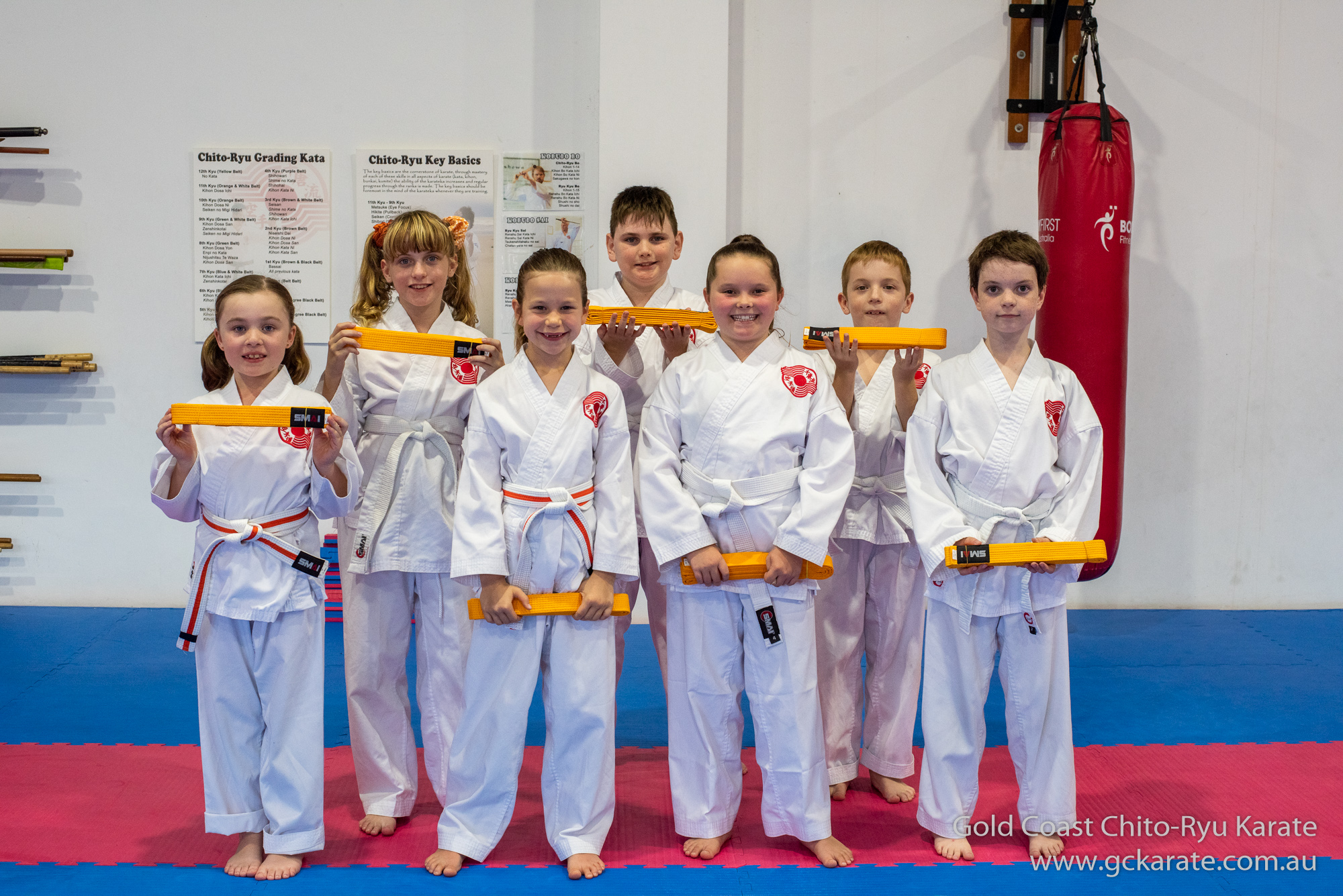
    The final grading of what has been an interesting year saw a very interesting grading with a range of results.

    In our White belt and Yellow belt grading we saw some solid performances with the majority of students successfully moving up the ranks.

    In these first groups of the grading we also had a few students with previous rankings in other styles. At the Gold Coast dojo students who arrive from another style of martial arts are asked to wear a white belt as they have no rankings in Chito-Ryu Karate. Whilst wearing their white belt they are assessed on their skill levels, their ability to adapt to and adopt the Chito-Ryu technique, and also on their character and humility. From their these students are grading to the level deemed appropriate for them to learn the Chito-Ryu skills building blocks required for continual development.

    Developing the correct building blocks for Chito-Ryu karate is essential, if everything is in place and working well then the student will make steady continual progress. If a building block is not in place then somewhere down the track things will begin to fall apart and progress will stall. In this grading a number of students were told “not yet”. Whilst this can be a hard experience for the student (it is also hard for the instructor), the time taken to get these building blocks solidly in place will eventually lead to achieving the black belt goal faster than if they had been passed for this grading.  If you were unsuccessful in this grading continue to work hard and focus on getting those building blocks in place and you will be ready for the next opportunity to step up to grade.

    Congratulations to the following on successfully passing your grading:

    12 Kyu (Yellow) – Charli Hyland
    12 Kyu (Yellow) – Daisy Ridley
    12 Kyu (Yellow) – Henry Duyvestyn
    12 Kyu (Yellow) – Isabella du Plessis
    12 Kyu (Yellow) – Nicolette Ridley
    12 Kyu (Yellow) – Sienna Bauer
    12 Kyu (Yellow) – Skye Wright
    11 Kyu (Orange & White) – Francis Guillon  *Double Graded
    11 Kyu (Orange & White) – Jesse Barker  *Double Graded
    11 Kyu (Orange & White) – Tom Allibone  *Double Graded
    11 Kyu (Orange & White) – Aissa Symons
    11 Kyu (Orange & White) – David Ford
    11 Kyu (Orange & White) – Max Chattin
    11 Kyu (Orange & White) – Sam Peddie
    11 Kyu (Orange & White) – Tilly McMillan
    10 Kyu (Orange) – Adam Glachan  *Triple Graded
    10 Kyu (Orange) – Kayden Kloot
    10 Kyu (Orange) – Millicent Mansbridge
    10 Kyu (Orange) – Sienna Curtis
    9 Kyu (Green & White) – Addison Schnebli
    9 Kyu (Green & White) – Cooper Shaw
    9 Kyu (Green & White) – Erika Baritchi
    8 Kyu (Green) – Byron Corbelli
    4 Kyu (Purple) – Merryn Jaffers


  • 2020 Summer Grading

    2020 Summer Grading

    Date:  Friday 4 December


    Schedule:

    Summer Grading Schedule
    Time Gradings Belt Size
    17:00 White -> Yellow
    Henry Duyvestyn 1
    Skye Wright 1
    Jesse Barker 2
    Isabella du Plessis 2
    Daisy Ridley 2
    Sienna Bauer 3
    Francis Guillon 3
    Nicolette Ridley 4
    Tom Allibone 5
    17:30 White + Yellow -> Orange & White
    Tilly McMillan 2
    Aissa Symons 2
    Tyman Yorke 2
    Max Chattin 4
    David Ford 5
    Adam Glachan 5
    18:00 Orange & White -> Orange
    Kayden Kloot 1
    Sienna Curtis 3
    Millicent Mansbridge 4
    Orange -> Green & White
    Cooper Shaw 1
    Erika Baritchi 2
    Addison Schnebli 2
    Bohdi Valencour 2
    Mehi Whala 2
    18:30 Green & White -> Green
    Isabella Ker 2
    Hana Nishiura 2
    Jack Forde 3
    Kaylah Smith 3
    Byron Corbelli 4
    Green -> Blue & White
    Yuvi Whala 3
    Blue & White -> Blue
    Blue -> Purple & White
    Hunter Smith 3
    Purple & White -> Purple
    Merryn Jaffers 3


  • Committed to Black Belt Seminar

    Committed to Black Belt Seminar

    On Sunday  8 November we held a “Committed to Black Belt” seminar at the Ashmore dojo.
    At Gold Coast Chito-Ryu Karate we do not have any special “Black Belt Clubs” that provide extra opportunities for those that pay for it. As far as we are concerned every student that walks in the door and is committed to training is in our black belt club.

    We do however hold a special seminar every couple of years where kyu grade students can come and attend a training session with the black belts, to experience how the black belts train as well as listen to advice and stories about how our black belts overcame their challenges and achieved their goals.

    Adam Sensei also shares more about what he looks for and his expectations of students wanting to get a black belt. Being a black belt is more than just being good at kicking and punching. It is made clear that whilst everyone is able to get a black belt only a select few will have the commitment to do what is required to get there (and beyond).
    It was a great way to start the day.
    Thank you to those that attended and to all our yudansha for making the effort to help out the next generation of black belts.
  • Dojo Re-Opening – Updated

    Dojo Re-Opening – Updated

    We are pleased to announce following the release of government guidelines that we are anticipating on re-opening the dojo on Friday 12 June. Tuesday 2 June.

    We will of course continue to monitor the situation and advise of any changes to this date.

    New Members Welcome

    We have space in some of our classes for extra members.  Book a free trial lesson now – Free Trial


  • 2020 Autumn Grading

    2020 Autumn Grading

    This was a very special grading with the current events of the world and as it has turned out, our last major event for a while due to COVID-19.

    We had a large number of students step up to grade. Some hadn’t graded for a while, others had stepped up from the Little Champions and others were just starting their karate journey. As an instructor we can sometimes get caught up in looking with to much of a critical eye as we look for ways to help our student improve. A grading can be a little bit different, yes we still need to apply a critical eye, but at the grading it is an opportunity to see just how much each student has learnt and grown since last time they stepped up.  This grading was one where I found myself often thinking “Wow, such and such has really improved”.  Whilst I try to keep a stoic face when conducting gradings I am sure the pride I was feeling inside must have been showing at times.

    Well done to all students who successfully graded:

    • Max Chattin – 12 Kyu (Yellow)
    • Darcey de Byl – 12 Kyu (Yellow)
    • Aaron Higgins – 12 Kyu (Yellow)
    • Millicent Mansbridge – 12 Kyu (Yellow)
    • Halle Peddie – 12 Kyu (Yellow)
    • Sam Peddie – 12 Kyu (Yellow)
    • Aissa Symons – 12 Kyu (Yellow)
    • Isabella Ker – 11 Kyu (Orange & White) ** Double Graded **
    • Max Ker – 11 Kyu (Orange & White) ** Double Graded **
    • Kayden Kloot – 11 Kyu (Orange & White)
    • Abigail Weeks – 11 Kyu (Orange & White) ** Double Graded **
    • Zavia Cole – 10 Kyu (Orange)  *** Triple Graded ***
    • Toby Somerville – 10 Kyu (Orange)
    • Bohdi Valencour – 10 Kyu (Orange)
    • Mehi Whala – 10 Kyu (Orange)
    • Byron Corbelli – 9 Kyu (Green & White)
    • Yusuf El-Deeb – 9 Kyu (Green & White)
    • Jack Forde – 9 Kyu (Green & White)
    • Liam Glover – 9 Kyu (Green & White)
    • Ellen Guan – 9 Kyu (Green & White)
    • Kaylah Smith – 9 Kyu (Green & White)
    • Jean du Plessis – 8 Kyu (Green)
    • Yuvi Whala – 8 Kyu (Green)
    • Dixon Garland – 7 Kyu (Blue & White)
    • Cooper Higgins – 7 Kyu (Blue & White)
    • Merryn Jaffers – 6 Kyu (Blue)
    • Kieran Milloy – 6 Kyu (Blue)
    • Johan Shajee – 6 Kyu (Blue)
    • Hunter Smith – 6 Kyu (Blue)
    • Millie Dorley – 5 Kyu (Purple & White)
    • Amelie Ollivier – 5 Kyu (Purple & White)


  • Little Champions Tournament

    Little Champions Tournament

    At the start of each year before the competition season begins we hold a Little Champions Tournament at the dojo.  This event in a familiar supportive environment gives our Little Champions a taste of what competition is like before the main events during the year.  We have always found this to be a great stepping stone event with many of the competitors going on to achieve great success at the bigger tournaments.

    This years event saw a record number of competitors register and the standard was very high with so many of our Little Champions showing how hard they have been working recently. The winners were very deserving of their awards but there was many other competitors that could have easily taken one of the places as well.

    I was very pleased with the courage shown by everyone in stepping up and having a go, you should be very proud of yourselves.  I was also exceptionally pleased with the fantastic manners and sportsmanship shown by everyone. A great example of what Chito-Ryu Tournaments are about.

    Results

    Kata 4-5 years LC – White–LC – Orange

    1. Elson Shi
    2. Jesse Valencour
    3. Finn McMillan


    Kata 6-7 years LC – White–LC – Orange

    1. Erika Baritchi
    2. Kalani Kloot
    3. Isabella Higham


    Kata 6-7 years LC – Green–LC – Black

    1. Cooper Shaw
    2. Hana Nishiura
    3. Addison Schnebli


    Kumite Tag 4-5 years LC – White–LC – Black

    1. Jesse Valencour
    2. Elson Shi
    3. Finn McMillan


    Kumite Tag 6-7 years LC – White–LC – Black

    1. Cooper Shaw
    2. Bryson Lee
    3. Addison Schnebli


    Kumite 4-5 years M LC – White–LC – Black

    1. Jesse Valencour
    2. Finn McMillan


    Kumite 6-7 years Mixed LC – White–LC – Black

    1. Addison Schnebli
    2. Cooper Shaw
    3. Kalani Kloot


    The photo album from the event can be found on our facebook page – https://www.facebook.com/gckaratekobudo/


    A big thank you to our leaders who helped out, I and I am sure all our Little Champions appreciate your time and efforts:

    • Kieran Milloy (who also took all the photos)
    • Charlotte Shaw
    • Siani Symons
    • Bohdi Valencour
    • Cooper Higgins (who looked after all the scoring and time keeping)


    Also a big thank you to our Seniors who gave up their time to be judges:

    • Monica Lester
    • Kazumi Tominaga


    Thanks everyone! (Don’t those Dojo T-Shirts look great)
  • 2020 GC Karate Competition

    2020 GC Karate Competition

    The first major karate Tournament for Queensland Chito-Ryu Karate is being held on the Gold Coast on the 1 March.

    Entry is open to all Chito-Ryu Karate-Do members.


    • When: Sunday 1st March 2020
    • Where: Trinity Lutheran College (Senior Campus) – Ashmore Rd, Molendinar QLD
    • Hosted by:  GC Chito-Ryu Karate Club Inc.
    • Registration: 8:30am
    • Competition Starts: 9:00am
    • Entry Fee:    $40.00 per person (This allows entry into all events)
    • No entries will be accepted after Saturday 22nd February 2020
    • Age: 4 years+  (There is division for all age groups)


    [maxbutton id=”8″]


    [maxbutton id=”9″]


    Events:

    Kata

    • Kata will be judged using the flag system: – 2 competitors will perform their kata at the same time. At the completion of their kata the judges will indicate by flags which competitor has won the round.
    • Competitors Orange belt and higher may not perform the same kata twice in a row.


    Team Kata

    • Team Kata will be judged using the flag system: – 2 teams will be competing against each other by performing their kata one at a time. At the completion of both kata the judges will indicate by flags which competitor has won the round.
    • Competitors Orange belt and higher may not perform the same kata twice in a row.


    Kobudo

    • Kobudo will be judged using the flag system: – 2 competitors will perform their kata at the same time. At the completion of their kata the judges will indicate by flags which competitor has won the round.
    • Competitors may not perform the same kata twice in a row.


    Kumite Tag

    • Competitors will compete against each other with the objective of removing a tag from the vest of their opponent using a good karate technique.
    • A mouthguard is compulsory for all kumite tag competitors.


    Kumite

    • ICKF kumite rules will apply.
    • Personal protective equipment is compulsory for all kumite competitors.
    • You must provide your own: groin guards (male), mouth guards, shin/instep protectors and gloves


    Conditions of Entry

    • Age divisions are determined by age as at the date of the tournament
    • International Chito-Ryu Karate Federation of Australia competition rules will apply at this tournament.
    • Competition organisers reserve the right to combine divisions if required.
    • All competitors will compete in bogu for kumite events as supplied or approved by organisers.


    Frequently Asked Questions

    Q. Is my child ready for tournaments?  (or am I?)

    A. Tournaments are a great learning experience no matter what age and belt level. Yes, they are nerve racking for both competitors and parents but from our experience all competitors come away with more confidence simply by being part of the tournament. The good thing about our Queensland Tournaments is that there is always plenty of support to help the students.

    Of course if you really are not sure then please discuss with your instructor.


    Q. Do you have to do every event?

    A. No, you are welcome to enter only the events you are comfortable with.  For some people starting with just individual kata and/or team kata is a great first step towards tournaments.


    Q. How do I find a team for Team Kata?

    A.  Ask your friends to be in your team, ask your instructor, keep an eye out on the noticeboard or facebook for people looking for team members. When selecting team members it usually best to select team members of similar rank and age as the division you are in will depend on the level of the highest ranked team member.


    Q. What time will the Little Champions/Junior events finish?

    A. It is not possible to give exact times until all entries have been received and a schedule has been written up however as a guide we endeavor to have the 4-8yr olds finished before lunch, and ideally the 9-10 year olds as well. Of course you can leave after your events but we do encourage everyone to stay and watch the senior divisions as well.


    Q. What time will the Tournament finish?

    A. It is not possible to give exact times until all entries have been received and a schedule has been written up however as a guide we are normally finished our tournaments from around 2:30-3:30pm. Presentation of the Little Champions Tournament Champion is done before lunch.  Presentation of the Junior and Senior  Tournament Champions Trophies are done at the end of the event.


    Q. Is there an entry fee for spectators?

    A. There is no entry fee for spectators. We do however appreciate it if you can support the club by purchasing lunch and snacks from the canteen.


    Q. What equipment do I need?

    A. Everyone needs a karate gi and karate belt. If you are doing Kumite Tag you will need a mouthguard, if you are doing kumite you will need mouthguard, gloves, shin/instep guard and groin guard (males).


  • 2020 Gold Coast Karate Calendars

    2020 Gold Coast Karate Calendars

    The 2020 Gold Coast Calendars are available to order for just $25.

    A great way to plan your karate year with each month highlighting all the karate events that are happening. 

    [wp_cart_button name=”2020 Calendar” price=”25.00″]

    * Orders close Saturday 15 February

    The 2020 Calendar features:

    • February 2020 – January 2021 Months
    • Large 28 x 37cm size.
    • All karate events highlighted
    • All Australian Public Holidays
    • Our very own Gold Coast Students
    • Motivational words


    Sample pages:


    Featured in the Calendar:

    • February – John Lenton
    • March – Hunter Smith
    • April – Kieran & Noah Milloy
    • May – Soke
    • June – Keahn Capon
    • July – Dixon Garland
    • August – 2019 Soke Cup Team
    • September – Brendan Young & Adrian Spoto
    • October – Isabella & Jean du Plessis
    • November – Levi Lenton
    • December – Lillian Richards
    • January – Sensei Adam Higgins